I met Priscilla Colón at the Unicode Technical Workshop in Nancy, France, which ended on 23 October. She was a speaker on the opening panel, Unicode in the World: Telling the Story, Today and Ahead, and I was drawn to the work she is doing to revive the Taíno language of the Caribbean. We had a long conversation afterwards. The more we spoke, the more I understood the passion behind her work and how determined she is to see the change through. I asked if I could interview her for my blog, and she kindly agreed. This post is based on that interview. A Tamil version is published in Sellinam.
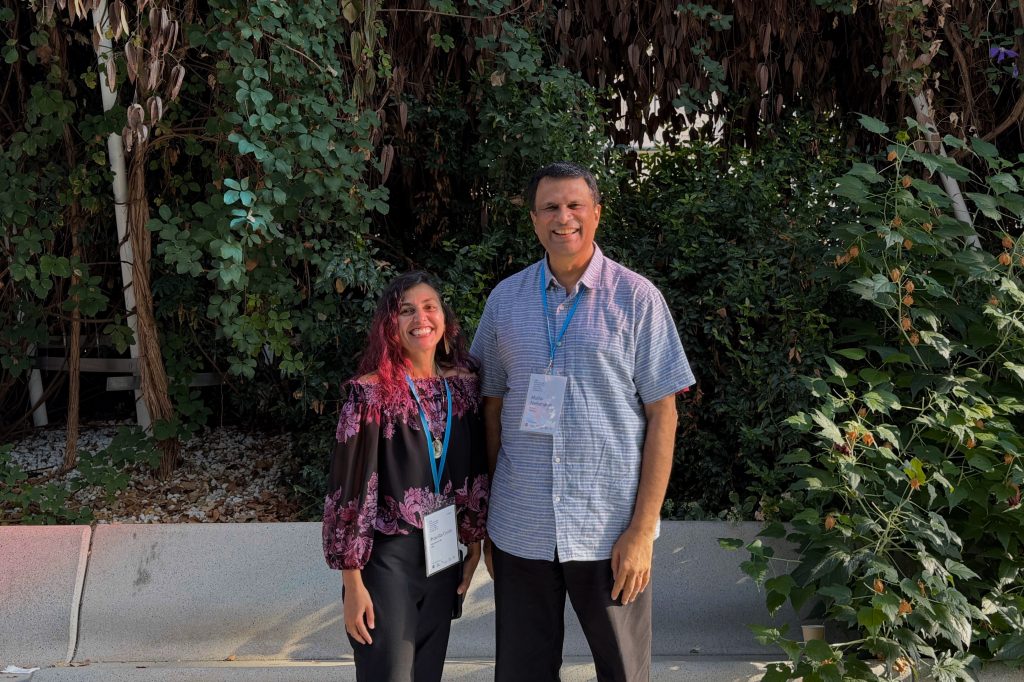
Priscilla and Casa Areyto
Priscilla is a Taíno teacher whose family comes from Borikén, today known as Puerto Rico. She now lives in the United States. She runs Casa Areyto, an organisation dedicated to revitalising the Taíno language, and she is co-chair of Ad-hoc Group 1 for the United Nations International Decade of Indigenous Languages. Her aim is to raise awareness of Taíno and help bring it back, since it is still considered extinct. She also wants to help Indigenous communities around the world revitalise their own languages.
Why Taíno is considered extinct
The Taíno were the first Indigenous people in contact with Europeans, when Columbus arrived in 1492. According to Priscilla, the language began mixing with Spanish, French and English quite quickly, and the Europeans in turn started adopting Taíno words. Within a couple of hundred years the original language of her ancestors was lost. She points out that when people in Puerto Rico say they speak Puerto Rican Spanish, they are actually speaking an Indigenous language that has been mixed and has changed over time. She sees this as a natural process, because people who meet start sharing, and then simplifying, the way they speak and write. Since no one speaks the original language itself, it came to be classified as extinct.
There’s another layer to it. In the 1550s, she said, the Spanish crown declared the Taíno people extinct, and that claim was then taught over and over. Priscilla calls it a paper genocide, a way of erasing people from the official record. She sees modern science as telling a different story. She cited a figure that about 61 percent of Puerto Ricans carry Indigenous DNA, which comes from a 2003 survey of the maternal line. Studies of the whole genome measure ancestry differently, and how much of it is Taíno is still being worked out. Her point is that the people were never extinct, and that the language evolved.
Rebuilding a language without recordings
Nobody recorded Taíno before 1492. What exists are written records, mostly by Spanish and French writers who wrote down each word the way they thought they heard it, so they are full of inaccuracies. There isn’t enough documented to speak the language the way her ancestors did. The revitalisation was undertaken by Javier Hernández, a hyperpolyglot, who researched it for nine years. Priscilla described his method in three parts.
The first part was research: finding the language in the old texts, and the Taíno words that survive in Spanish, French and other languages today. Priscilla said that almost everyone in the world already speaks some Taíno, in words such as hammock, hurricane, canoe and barbecue. In her spelling, these are jamáka, jurakán, kanóa and barbakóa. The second part was borrowing from sister languages around the Caribbean, including languages in South America that still have hundreds of thousands of speakers. She was clear that borrowing words is perfectly acceptable. The third part was creating new words, because the language has to cope with things her ancestors may not have had, such as avenue, car, continent, computers and refrigeration. As she put it, “we don’t want to just sit around a fireplace talking about baking cassava bread.”
Linguists who have looked at these revival projects note that a language rebuilt this way will differ from the original, because the sources are few and some words are borrowed or newly made. Priscilla is open about that, as her own description of the three parts shows.
Priscilla found Hernández’s book. She had worked as a teacher, in educational publishing and in language-learning software, so she realised she could start learning the language and teaching it to others around the world.
Response so far
Priscilla describes herself as a person of action. She has posted more than 550 videos on YouTube about the language and culture, and she has just published the first digital courses, in English and Spanish, so that most descendants can have access. She also gets photos and videos of children learning the language on their iPads.
She told me about one comment from the early days, when she was new to YouTube and had about 17 followers. A young man wrote, “My name is David. I’m 15 years old. I’m learning Taíno. I’m going to teach my kids and I hope that they teach their kids.” Priscilla knew then that she had touched three generations, and she says everything else since has been extra.
The first international conference she organised was held in 2023 in Puerto Rico. The second was held online to make it more accessible, with speakers of Mayan, Quechua, Lakota and Hawaiian descent and participants from around 12 countries. She doesn’t see this as work for the Taíno community alone. Her ancestors were always welcoming to new people, and she says the movement needs allies.
LILI: the Living Indigenous Languages Initiative
LILI brings together her work for the Taíno community and her work for the International Decade of Indigenous Languages. Priscilla said it came from deep in her heart, and that she only recently understood why. Before 1492, the Taíno received people from across Indigenous America, North, Central and South. They had a ceremony, guaitiáo, through which a visitor could become part of the family, something like a blood brother or sister bond. They also invited others to come and learn, and to play the ball game they were known for. LILI continues that tradition.
She has sent a proposal to UNESCO, and had a meeting with them, to open Borikén to Indigenous peoples from around the world. Over five years, groups would come to the island for residential programmes of five to seven days and learn from the land. Students would meet young people from other communities, and educators could exchange ideas on language education. Advocates could work on moving from commitment to actual policy.
Then each group goes back to its own country and takes an action. It doesn’t have to be big, and could be a book fair or a meeting with state legislators. The group reports on it to the Global Task Force of the International Decade, so the outcomes are measurable and the community has officially contributed to the Decade. Priscilla sees it as a model for any Indigenous community, not only the Taíno. She also explained the name: a lily grows in the muck, in the dirt, and comes up no matter where it grows.
Priscilla in Taíno
Priscilla closed the interview with a few lines in Taíno: “Tau, dak’anúlia Priscilla Colón. Dak’kepiá mun Estadunídarat, mem dak’ât apúxi guaríko Borikén, sokaí rokó Puerto Rico.” In English, she said hello, gave her name, and said that she lives in the United States but her family comes from Borikén, today known as Puerto Rico.
What I took from this for Tamil
Listening to Priscilla, I thought about the many people who work to keep Tamil in daily use. Their circumstances are different from hers, however the work looks familiar. Someone teaches a class at the weekend. Someone builds a font, a keyboard or a dictionary. Someone records a video for children, or writes a book for them. Most of this is done quietly, and often without much recognition.
Two things in her approach stayed with me. She started with one book and a few videos, and she kept going until the response came. Her first real sign that it was working was a comment from a teenager. She also asks everyone who joins LILI to go back home and take an action, however small, and to report on it. A language is kept alive by many small actions of this kind, and I think that applies to Tamil as much as to Taíno.
Her work also made me think about how a language can take on new uses without being cut off from its past. The words that Priscilla and her colleagues create for avenues, cars and computers sit alongside what survives of the old language. Tamil has a long written record to stay connected to, and keeping that record in view while the language moves into phones, classrooms and new tools is something many of us are working on.
I thank Priscilla for her time and for the work she is doing, and I wish her and LILI every success!